Service-Area Business SEO in India: Rank in Multiple Cities Without Fake Offices or Doorway Pages
A policy-safe local SEO guide for Indian service-area businesses covering Google Business Profile setup, useful city pages, local proof and multi-city measurement.
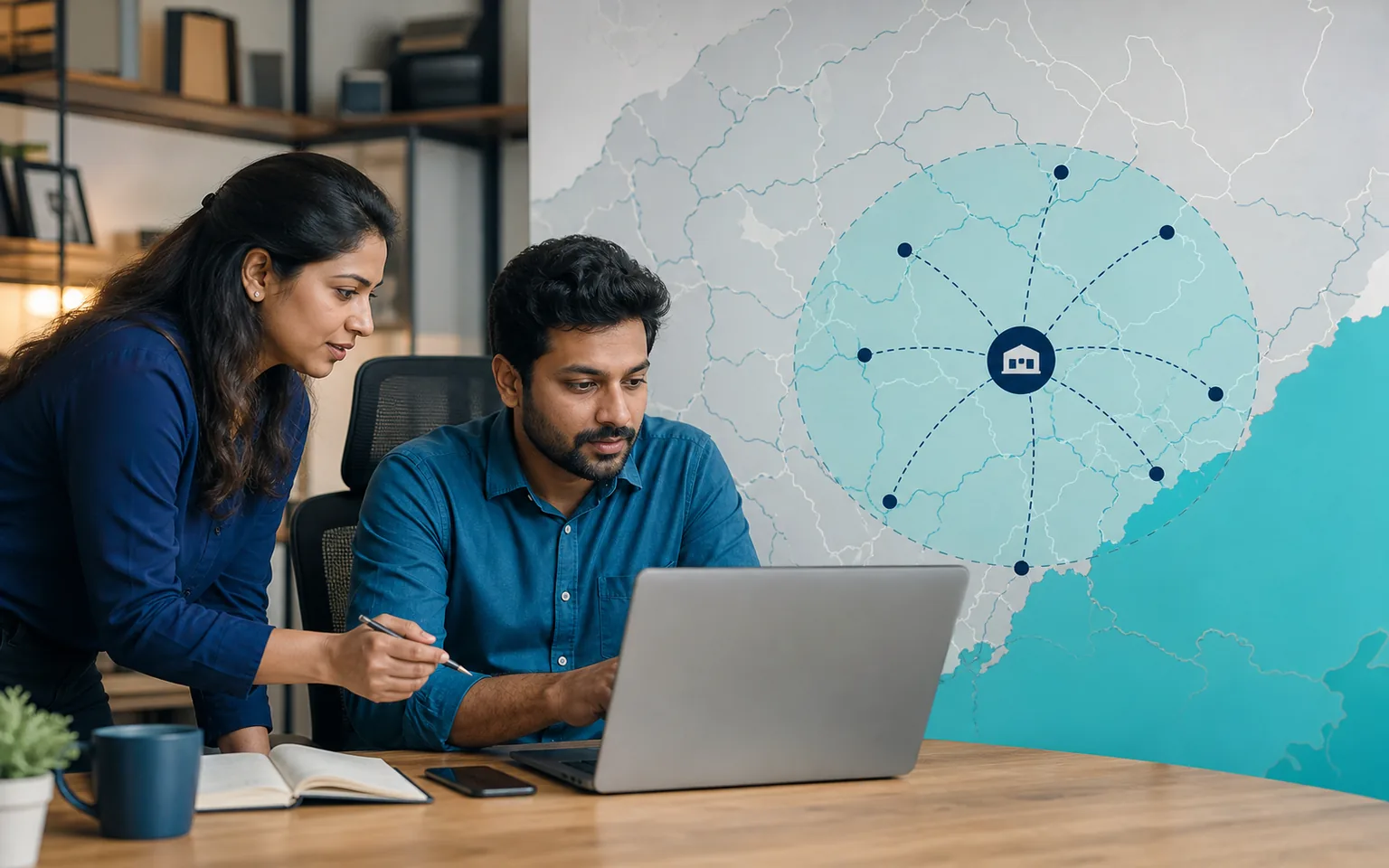
A service business may travel to customers across several cities without operating an office in each place. That creates a legitimate local SEO challenge: how can the business explain its coverage and earn visibility without creating fake locations or hundreds of near-identical city pages? The answer is to align the Google Business Profile with real operations and build website pages that help people make a local decision.
This guide is for contractors, consultants, home-service providers, healthcare-at-home teams, agencies and other businesses that visit or serve customers away from their premises. It focuses on durable practices rather than map-pin shortcuts or ranking promises.
Identify the correct business model first
Storefront business
A storefront receives customers at a genuine, staffed location during its stated hours. The address can be displayed when customers can actually visit and the location meets Google guidelines.
Service-area business
A service-area business travels to customers and does not serve them at its business address. It should hide that address on the Business Profile and specify the areas it serves. A home address should not be displayed merely to create a local pin when customers are not received there.
Hybrid business
A hybrid business receives customers at a staffed location and also travels to them. It may display the address and add service areas when both parts are genuine. Choose the model that matches operations rather than the option that appears to cover more searches.
Google's Business Profile representation guidelines, checked on 24 August 2026, explain these distinctions and generally advise maintaining one profile per business. The profile name should represent the real-world business name, not a list of services and cities.
Set service areas accurately
Google's service-area guidance says businesses add areas such as cities or postcodes rather than drawing a radius. At the time of this policy check, a profile could specify up to 20 service areas, and Google advised keeping the overall boundary within roughly two hours of driving time from the business base. The exact feature and policy should be reviewed before changes are made.
Select places the team routinely serves. Do not add an entire state because one customer once made a remote enquiry. Accurate coverage improves the customer journey and makes website content easier to support with real evidence.
Use city, district or postcode choices available in the profile interface.
Hide an address where customers are not served.
Keep opening hours aligned with the hours customers can receive support.
Review areas when staffing, travel capability or operations change.
Do not create a second profile merely for another service area.
Avoid fake offices and duplicate profiles
A virtual office is not a shortcut to a map presence. Google's guidelines state that an office in a coworking environment may be eligible only when it has clear signage, receives customers at the location during business hours and is staffed by the business's own team. A mailbox, forwarding address or meeting room used occasionally does not establish a genuine branch.
Separate profiles may be appropriate for genuinely distinct staffed locations that meet the guidelines. Each location should have its own real address, local team and customer-facing operation. Do not create city profiles that all route to one hidden base. Suspensions and trust problems are expensive to investigate, and a profile restored after enforcement is not guaranteed to regain previous visibility.
Understand what influences local results
Google's local ranking guidance describes three broad factors:
Relevance: how well the profile and business information match what the person is seeking.
Distance: how far the business is from the location term or the searcher's inferred location.
Prominence: how well known the business is, including signals such as links and reviews.
Adding a service area does not make the business physically close to every searcher in that area. It describes coverage; it is not a radius-ranking control. Complete information, appropriate categories, genuine reviews, a useful website and consistent operations support relevance and prominence, but no legitimate provider can guarantee a map position.
Choose a website structure that matches real coverage
Begin with one strong service page that explains the offer, process, eligibility, service boundaries, evidence and next step. Then create a location page only when the business can add information useful to a customer in that place.
A practical structure may include:
a primary service hub linked from the main navigation;
individual service pages for meaningfully different offerings;
a coverage hub listing verified cities and the way service is delivered;
selected city pages with local logistics, proof and questions;
case studies, testimonials and contact details connected to relevant pages.
Tyon's SEO services can help organize this architecture. The existing local SEO guide for Indian service businesses covers the broader profile, website and reputation foundation.
What makes a city page genuinely useful
A city page should answer questions a customer in that city would reasonably ask. Changing the city name in a generic template is not local value. Before publishing, confirm that the team can support the claims and keep the page current.
Service availability: which exact services are offered in the location and any genuine limitations.
Delivery model: whether work is remote, on-site or hybrid and how scheduling works.
Local process: realistic travel, inspection, onboarding or support details.
Relevant evidence: a case study, testimonial or project example from the area where permission exists.
Local questions: FAQs based on actual enquiries rather than keyword variations.
Clear next step: an enquiry form or contact method that identifies the location and service.
If the business cannot provide meaningful local information, a clear coverage section on the service page may serve customers better than a separate URL. Page count is not evidence of local expertise.
Know the doorway-page and scaled-content risk
Google's Search spam policies describe doorway abuse as pages created for similar queries that funnel users to one destination, including substantially similar regional or city pages. The policies also address keyword-stuffed location lists and scaled content created mainly to manipulate rankings rather than help people.
The risk depends on purpose and value, not whether a person or AI produced the text. Ten thoughtful pages can be more useful than five hundred automated variants. Do not index a location page until it passes a quality review.
Does the business genuinely serve this location now?
Does the page provide information not already available on every other city page?
Can each local claim be verified?
Would a customer find the page useful without the city keyword?
Is there a responsible owner and update date?
Does the page lead to a location-aware next step rather than one generic doorway?
Build local proof without manufacturing it
Useful proof comes from real work and transparent business information. Publish a case study only with permission and describe the starting problem, work completed and outcome that can be supported. Do not invent client names, locations, reviews or performance figures to fill a template.
Reviews should reflect genuine experiences and should not be bought, gated or scripted. Link a relevant testimonial to the service and city only when it actually relates. Photos should represent the team, equipment, project or location rather than a stock image presented as a completed job.
Local partnerships, professional memberships and citations can support discovery when they are real and relevant. Avoid bulk directory submissions that create inconsistent details or exist only to manufacture links.
Optimize each page for people and search systems
Title and main heading
Use the service and location naturally. The heading should describe the offer rather than repeat several keyword variations. Keep the promise aligned with what the business can deliver.
Introductory answer
Explain who the service is for, whether it is available in the location and how delivery works. Do not force the reader through a long brand story before answering the local question.
Internal links
Link from the service hub and coverage page using descriptive text. Connect city pages to the most relevant service, case study and contact route. Avoid placing a footer block containing every city on every page if it does not help navigation.
Structured data
Google's LocalBusiness structured data documentation explains how eligible business details can be represented. Use the most specific accurate type, match visible information and validate the markup. Structured data does not create a branch or guarantee a rich result.
Technical quality
Make pages mobile-friendly, fast, indexable only when ready and included in the canonical site structure. Use self-referencing canonicals for genuinely distinct pages. The technical SEO audit guide outlines crawl, rendering and indexation checks that can affect local landing pages.
Measure multi-city SEO without a ranking promise
Track performance by page, service and location using first-party data:
qualified organic enquiries with landing page and location;
Google Business Profile calls, website clicks and direction requests;
Search Console queries and pages, reviewed as trends rather than exact rank guarantees;
conversion from enquiry to qualified opportunity by service area;
wrong-location enquiries, cancellations and operational coverage gaps;
page freshness, local proof and broken contact paths.
Compare each location with its own baseline and business capacity. A page that attracts traffic outside the serviceable area may need clearer boundaries, not more keywords. The local SEO pricing guide explains the work involved in profile, content, technical and reporting activities without promising a position.
A safe rollout sequence
Verify operations: list actual cities, delivery capacity and responsible teams.
Correct the profile: choose the correct business model, address visibility, categories and service areas.
Strengthen service pages: ensure the core offer and process are clear before creating local variants.
Pilot a small group: publish city pages only where distinct local information and proof exist.
Review quality: check claims, duplication, internal links, forms, mobile usability and indexation.
Measure and maintain: update coverage, remove unsupported claims and consolidate pages that add no independent value.
Frequently asked questions
Can a service-area business rank in a city without an office there?
It may be eligible to appear based on relevance, distance, prominence and other signals, but no setting guarantees visibility. Use an accurate service area and a useful website; do not create a fake office.
Should the address be hidden?
Hide it when the business travels to customers and does not serve them at that address. A hybrid business that genuinely receives customers at a staffed location may display it, subject to current guidelines.
How many city pages should a business create?
There is no universal number. Create only pages supported by real coverage, distinct information, local evidence and maintenance capacity. A smaller useful set is safer than a mass of interchangeable pages.
Can the same testimonial appear on several pages?
A relevant testimonial may be referenced where it helps, but it should not be presented as local proof for cities unrelated to the customer's experience. Explain the context honestly.
Policy note: Google Business Profile and Search policies cited here were checked on 24 August 2026 and can change. This article is general SEO guidance, not a guarantee of ranking, verification or reinstatement. For a coverage and content audit based on real operations, contact Tyon Technologies.
Topic hub
Explore the Digital Marketing cluster
Move between the main service, focused solutions, practical articles, and pricing guides without searching the full website.